
Why Are Resistance Band Exercises for Persistent People?
Introduction
Persistence isn’t about forcing progress—it’s about staying committed and
moving forward, step by step.
Resistance band exercises are a perfect metaphor for this: they stretch, resist, and reward, just like the journey of living a healthier, stronger life.
For young people, resistance band exercises are an excellent way to explore strength training safely.
For senior beginners, they offer a gentle, empowering path to regain confidence, mobility, and independence.
Research shows that physical activity in older adults is strongly linked to higher psychological resilience, which supports both mental and physical well-being (O’Doherty et al.).
The Spark Behind the Band
Every wellness journey starts with a motive—a reason to begin. Resistance band exercises meet that call with simplicity and accessibility:
- Accessibility: No gym membership or heavy equipment—just the will to start.
- Adaptability: They meet you at your level, whether you’re 20 or 70.
- Symbolism: Each stretch mirrors the effort of pushing through life’s resistance.
Persistence comes from motivation, but it grows through practice and overcoming challenges—exactly what resistance bands teach us.

Persistence in Action
Using resistance bands teaches us about persistence in a tangible way.
Each stretch pushes against resistance, requiring patience and control.
For older adults, this practice is especially powerful: even gentle or low-frequency activity has been shown to increase resilience in seniors, improving coping strategies, mood, and overall well-being (Smith et al.; see Physical Activity and Psychological Resilience in Older Adults).
Persistence isn’t measured by time spent; it’s measured by how you face challenges and keep moving forward, even when progress is slow. Each session with a band is a micro-lesson in resilience:
- Daily discipline: Small, repeated actions compound into strength.
- Progressive challenge: Resistance increases as you grow stronger, echoing personal evolution.
- Mental toughness: Staying committed when results are gradual builds character beyond the workout.
For younger users, persistence may naturally develop as they explore different exercises or environments.
For elderly beginners, the stakes are higher: persistence becomes a bridge to independence, confidence, and mobility, making motivation and guidance crucial (O’Doherty et al.).
Why Willpower Is Not as Important as Persistence
Persistence is more than sheer determination. Willpower is like a muscle: it tires when overused.
True persistence is strategic. It’s about preparing for challenges and seeing difficulty as a normal part of growth.
A persevering individual doesn’t push blindly—they plan, adjust, and recognize that struggle leads to improvement.
For seniors, this mindset is transformative: every completed exercise, every small victory, reinforces the belief that they can regain strength and confidence, step by step (Smith et al.).
Find your purpose
Persistence grows stronger when tied to purpose. Without a reason, effort feels meaningless, and quitting becomes tempting.
For example, an older adult rising early to train isn’t enduring the moment for its own sake—they’re reclaiming mobility, independence, and quality of life.
A younger adult may train for strength, aesthetics, or general fitness. Both find motivation, but the elderly rely more on structured guidance to connect effort to meaningful outcomes (O’Doherty et al.).
With every stretch and every rep, persistence reinforces confidence, creating a cycle of growth that strengthens mind and body together.

How to Integrate Persistence in Your Daily Life: Leap Toward Wellness
Wellness doesn’t require grand gestures. A single resistance band can spark transformation:
- Starting small: One exercise becomes a habit.
- Momentum matters: Persistence turns effort into a lifestyle.
- Nutrition synergy: Balanced meals fuel the energy, recovery, and confidence needed to persist.
Resistance band exercises teach that consistency and purpose matter more than intensity or speed.
They are a daily reminder that progress is possible when we show up and keep moving.
Resistance band exercises and their benefits.
Resistance band exercises combine safety, versatility, and accessibility, making them ideal for all ages:
- Safety first: Bands reduce the risk of dropping or straining, perfect for seniors.
- Anywhere, everywhere: Fits in a drawer, suitcase, or handbag—ready at home, office, or travel.
- Low cost: Affordable, yet highly effective.
- Progressive growth: Bands come in varying resistance, allowing measurable improvements.
- Rehabilitation ally: Gentle resistance supports recovery after injury or inactivity.
- Psychological benefits: Reduces stress, builds confidence, and reinforces persistence (Smith et al.).
- Social benefits: Portable enough for group or family sessions, making wellness a shared experience.
Nutrition: The Band’s Best Friends
Nutrition works in tandem with exercise. Think of each nutrient as a team member supporting your persistence:
- Proteins: Repairs and builds tissue.
- Complex Carbs: Sustains energy.
- Healthy Fats: Supports recovery and brain function.
- Micronutrients & Hydration: Ensures optimal performance.
Together, they form a wellness ecosystem that keeps persistence sustainable.
Methodology for Different Ages
For Young People
Reps: 10–12 per exercise
- Tempo: Moderate, controlled movements
- Progression: Increase band tension or add sets as strength grows
- Goal: Build strength, endurance, and muscle tone.
For best results and safety, follow the detailed exercise instructions included with each resistance band set.
For Elderly Beginners
- Reps: 5–6 per exercise, progressing slowly
- Tempo: Slow, deliberate, with breathing pauses
- Support: Chair or wall for stability
- Progression: Add 1 rep per week if comfortable, or move to a slightly stronger band under supervision
- Goal: Improve mobility, confidence, and daily functionality (O’Doherty et al.; Smith et al.).
For best results and safety, follow the detailed exercise instructions included with each resistance band set.
Measuring Results
Track progress in ways that matter:
- Strength: Add one rep per week if safe.
- Mobility: Observe improvements in daily tasks.
- Endurance: Note reduced fatigue.
- Confidence: Track comfort and security during exercises.
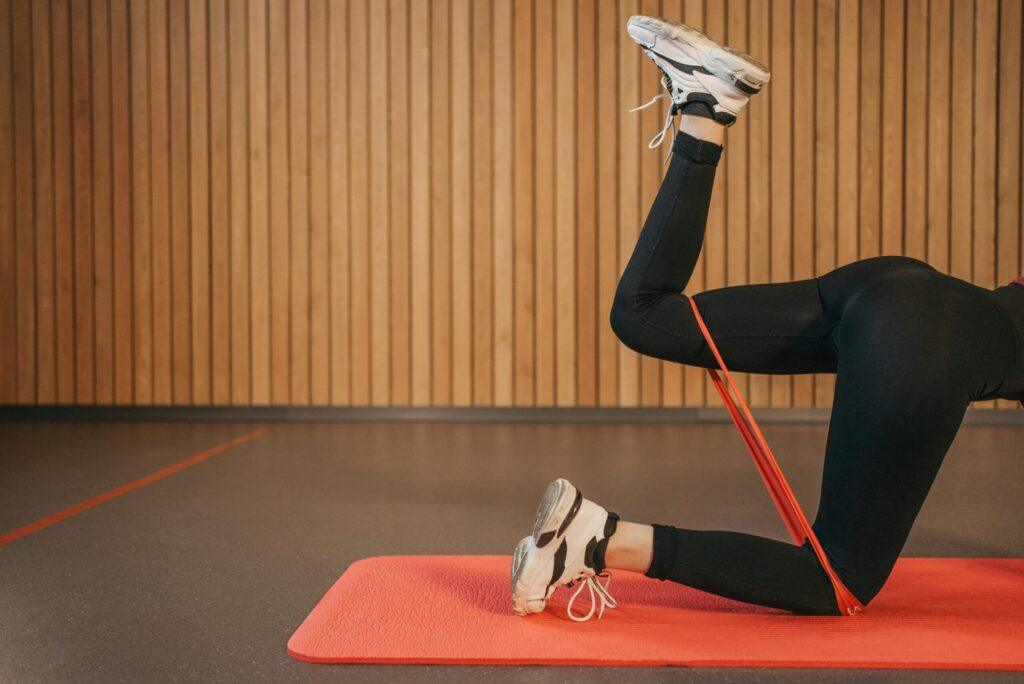
Gentle Resistance Band Exercises Program for Elderly Beginners
Frequency: 2–3 times per week
Duration: 15–20 minutes per session
Equipment: Light resistance band, sturdy chair, water
Warm-Up (3–5 minutes)
- Seated marching – 30 sec
- Gentle shoulder rolls – 5 forward, 5 backward
- Band pull-apart (light tension) – 5 reps
Main Routine (1–2 rounds, rest as needed)
- Focus on gentle, controlled movements targeting major muscle groups
Cool-Down (3 minutes)
- Gentle stretches for arms and legs
- Deep breathing to restore rhythm
Progression:
- Start with 5–6 reps per exercise
- Add 1 extra rep per week if comfortable
- Move to a slightly stronger band only under professional supervision
Benefits:
- Safety: Gentle resistance reduces injury risk
- Confidence: Simple, familiar movements build trust
- Mobility: Supports daily tasks like standing, reaching, and lifting light objects (O’Doherty et al.)
What to Remember About Resistance Band Exercises and Persistence Goals
The psychology of persistence reveals that people with a winning mind think differently, not because of superior willpower to begin with, but because of the mindsets they develop to alter their perspectives on struggle, failure, and time.
They focus on purposes, effectively regulate and control their emotions, balance optimism and realism, and design systems to develop persistent habits.
They don’t look at persistence as something worthy of praise but rather as the only thing that will allow true accomplishment.
Young people explore their strength; older adults, on the other hand, reclaim mobility and confidence.
Wellness is about steady progress, guided by self-control, purposeful effort, and mindful decisions.
“Persistence is not optional—it is the pathway to accomplishment, one stretch at a time (Physical Activity and Psychological Resilience in Older Adults).”
This may very well be the difference. Quitting is never an option for people who are persistence-minded. They understand that no matter what the obstacle, it is part of the journey, and failure is merely a learning experience.
References for further reading
O’Doherty, Maeve, Conor Cunningham, Ruth D. Neill, et al. “The Association of Resilience and Physical Activity in Older Adults: Cross-Sectional Analyses from the NICOLA Study.” Journal of Public Health, May 2024, https://link.springer.com/article/10.1007/s10389-024-02274-3?utm_source
“Physical Activity and Psychological Resilience in Older Adults: A Systematic Review of the Literature.” PubMed, 2024, https://pubmed.ncbi.nlm.nih.gov/37699587/.
Disclaimer: The information shared here is based on personal experience and publicly available research and is intended for educational purposes only. It should not replace advice from a qualified healthcare professional. Please consult a certified nutritionist, physician, or other licensed expert before making dietary, exercise, or fasting-related changes, especially if you have existing health conditions. The habits discussed are examples, not prescriptions, and readers are encouraged to review the referenced sources and make informed decisions for their own health. My habits are a guide, not a rule.